Pool chemical tracking software
Every reading, every dose and what it cost you, pool by pool. ShockRoute turns the test kit into the right amount of product, prices it from your own price book and shows which pools are eating your margin.
LSI, doses, cost per stop and profit per pool are on every plan, including free up to 10 pools.
Readings, LSI and dosing
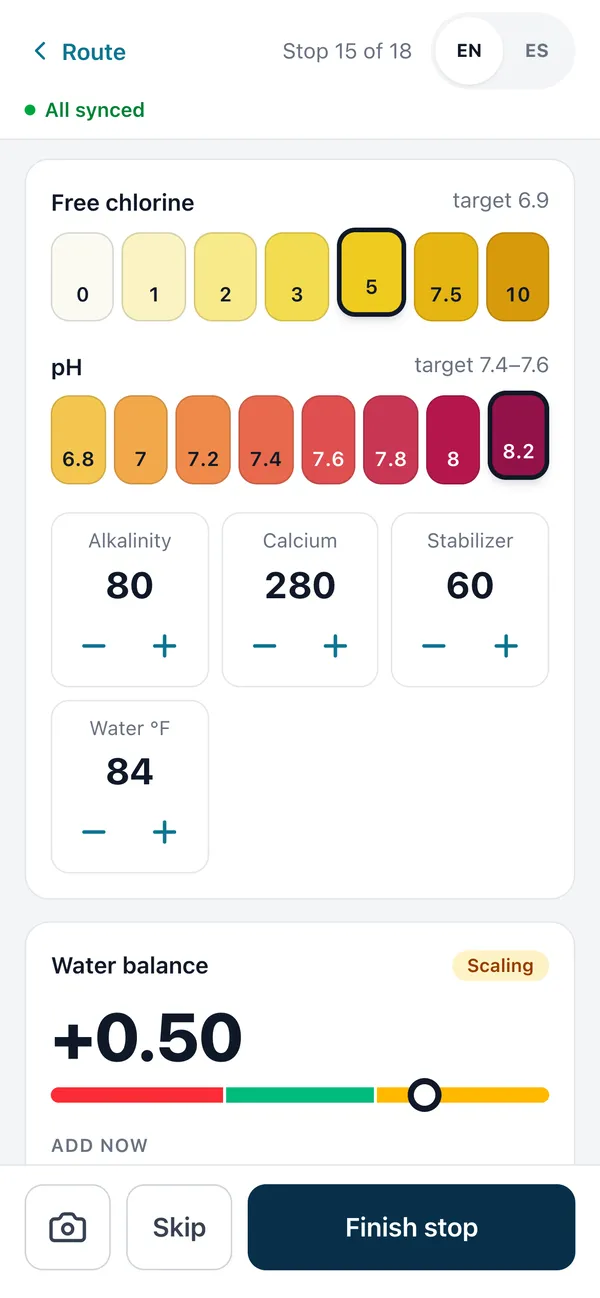
Techs tap the test-kit color for free chlorine and pH and step the rest: alkalinity, calcium hardness, stabilizer and water temperature. Each value starts from the last visit. ShockRoute works out the Langelier Saturation Index as they go and labels the water corrosive, balanced or scaling.
Doses use standard per-10,000-gallon factors, scaled to the gallons on file for that pool or spa. The chlorine target follows stabilizer, about 11.5% of the CYA reading with a floor of 3 ppm, so a heavily stabilized pool gets enough chlorine to stay clear.
What it recommends
- Liquid chlorine to reach the target free chlorine
- Sodium bicarbonate when alkalinity is low
- Calcium chloride when hardness is low
- Stabilizer when cyanuric acid is low
- Soda ash or muriatic acid for pH, scaled by alkalinity, marked retest
Want to check the math by hand? Use the free LSI calculator or the chlorine calculator.
Chemical cost per stop from your price book
Your price book holds what you pay and what you charge for each product, per unit. Every dose a tech puts in the water is priced at your cost on the spot, so each stop has a real chemical cost and each pool a running 30-day total. Update a price when your supplier changes it and new stops use it.
Customers on a plus-chemicals plan get those doses on their invoice at your bill price, grouped by product. See how that flows into billing.
Profit per pool
The profit page takes what each pool paid over the last 30 days and subtracts chemicals at cost, tech time on site and estimated drive. You set the labor rate, the cost per mile and your target margin; the defaults are $30 an hour, 70 cents a mile and 25%.
Pools that lose money or miss the target get a suggested rate. Change rates right in the grid, then draft rate letters to copy and send in your own words. The next invoices use the new rate.
Water history and customer reports
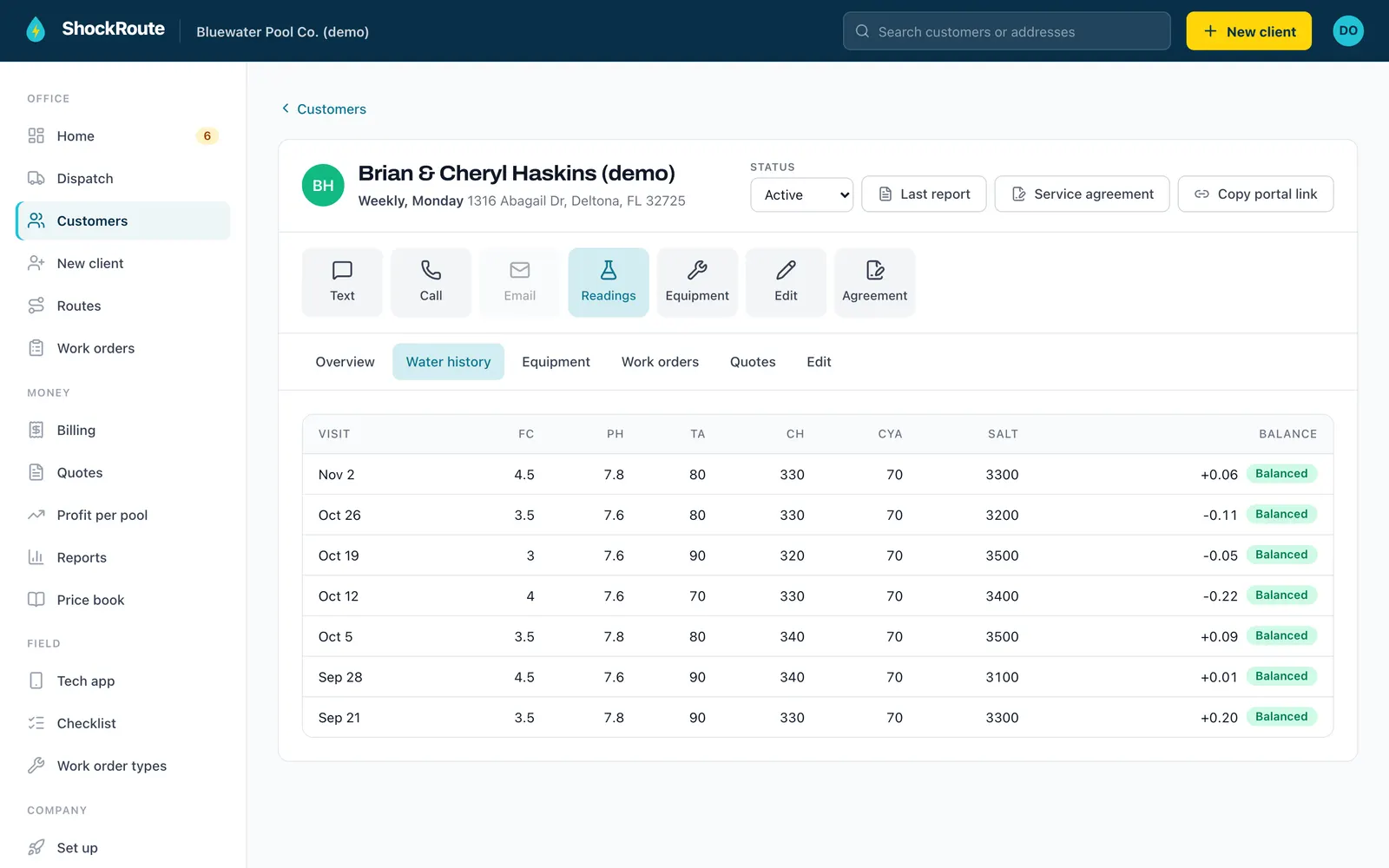
Each customer page has a water history with the last visits side by side, so a slow pH climb or a stabilizer creep shows up before the pool turns. The office sees off-balance pools from today on the home screen.
After each stop the customer can get a visit report by email and a web link. Readings sit next to their ideal range, the balance is one plain sentence, and chemicals have names people know.
How it compares
Skimmer, a trademark of its owner, offers LSI and dosing on its Scaling Up plan through an Orenda integration, and its chemical dosages report recalculates past dates at your current chemical cost (checked Nov 2, 2026). ShockRoute prices chemicals when they go in the water and includes LSI and doses on every plan. Compare in ShockRoute vs Skimmer.
Frequently asked questions
How does ShockRoute work out the dose?
It uses standard per-10,000-gallon factors for each product and scales them to the pool's gallons. The chlorine target follows the stabilizer level, so a pool at 50 ppm stabilizer aims for about 5.8 ppm free chlorine. pH doses are scaled by alkalinity and marked retest.
Which chemicals does it recommend?
Liquid chlorine for sanitizer, sodium bicarbonate for alkalinity, calcium chloride for hardness, stabilizer for cyanuric acid, soda ash to raise pH and muriatic acid to lower it. The price book also lists 10% liquid, cal-hypo, dichlor, trichlor and salt.
Where does the chemical cost per stop come from?
From your price book. Each product has a cost per unit and a bill price per unit. When a dose goes in the water, ShockRoute prices it at your cost, so every stop has a chemical cost and every pool has a running total.
How is profit per pool calculated?
Over the last 30 days: what the pool paid, minus chemicals at your cost, tech time on site at an hourly labor rate and estimated drive at a per-mile rate. The defaults are $30 an hour, 70 cents a mile and a 25% target margin, and you can change all three.
Do customers see the readings?
Yes, in the visit report. Each reading shows next to its ideal range with low, OK or high, and the water balance is one plain sentence. Chemicals are listed by names people know, like baking soda, with what each one does. No prices appear.
Is chemical tracking on the free plan?
Yes. Readings, LSI, doses, the price book and profit per pool are on every plan. Plans differ only by how many pools you service.
Know what every pool costs you.
Free up to 10 pools. No card needed.